
I have just come back from a week walking the Malerweg (Painter’s Way) long distance footpath in Germany’s Elbe Sandstone Mountains.
Situated in the south east of the German state of Saxony, the Elbe Sandstone mountains stretch southwards into the Czech Republic. They consist of thickly wooded hills (the highest 560 metres above sea level), rising above the River Elbe gorge winding its way towards the North Sea, and are distinguished by incredible sandstone cliffs, gorges and plateau’s created by the rock’s varying rates of erosion. This has given the region strikingly bizarre, and pretty unique, rock formations. Some on a gigantic scale, others more boutique, all incredible to look at, especially when clustered together.


In 1990 one of the final acts of the old East German Parliament – shortly after the country’s first (and last) openly contested elections – was to declare the most remote and least developed parts of the region a national park. It retains this status in the expanded Federal Republic of Germany and has now become a very popular holiday destination for people across the country, having long been popular with day trippers and holidaymakers alike, especially from the nearby Dresden conurbation. Attractions include: steamships along the Elbe, little resort towns like Bad Schandau and “honeypot” sites (albeit well worth visiting) like the Bastei, Kirnitzschtalbahn and Königstein Fortress.


The Malerweg which I was following is an increasingly celebrated walking route launched in 2006, though it claims a far older pedigree. Another name for the Elbe Sandstone Mountains’ German section is the Saxon Switzerland, which features in the titles of both the national park and the region’s district council. Back in the 18th and 19th Centuries in Germany just like the UK wilder, less populated regions which historically people had avoided if at all possible, began to be recognised as possessing an imposing, even sublime natural beauty. Key to this early domestication of the landscape were two Swiss painters working at the Academy of Fine Art in Dresden Adrian Zingg and Anton Graff. Producing work in the Elbe Sandstone Mountains they nicknamed it “Saxony’s Switzerland” and the name stuck. It was not actually unusual in 18th and 19th Century Europe for upland areas seeing the development of early forms of tourism and the aesthetic commodification of nature.


Even more celebrated are the paintings of Caspar David Friedrich who was also based in Dresden created inspired by the region. A prominent German romantic painter, he often walked in the hills bordering the Elbe Valley, drawing upon the landscape he encountered to create works like the Wanderer above the Sea of Fog, which today hangs in Hamburg.
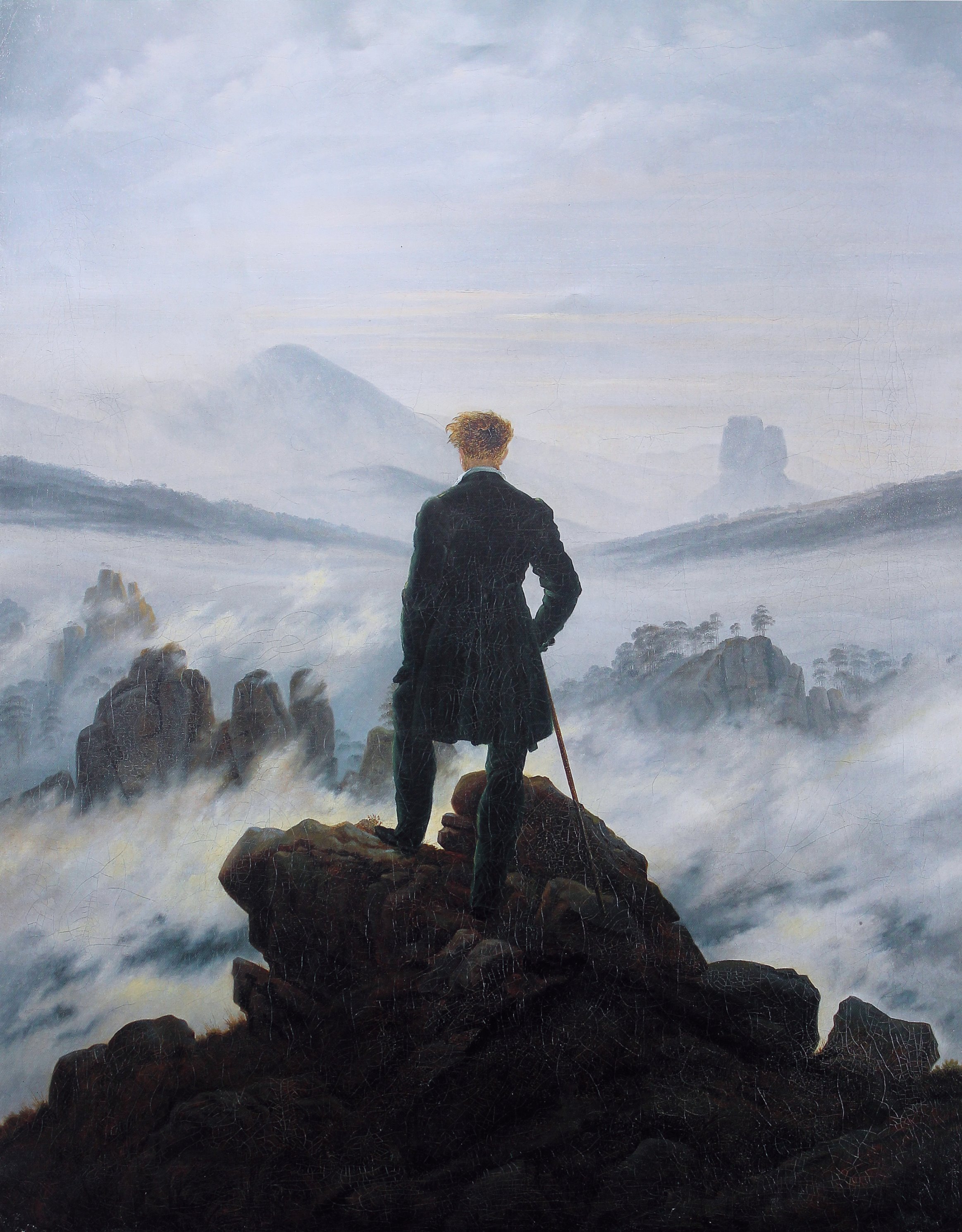

When the Malerweg was developed the route’s promoters drew upon the work of art historians and critics so as to develop a long distance footpath which would take in some of the places and views which have inspired visual artists since the 18th and 19th Centuries. This said, there are many things for walkers who are not interested in the art of German romanticism to enjoy along the way. From the physical exertion of the walk itself, to the impressive landscape, and discovering the Elbe Sandstone Mountains distinctive history and culture.


While walking the route I could not help but compare the Saxon Switzerland to places in the English Midlands. In pure geographical terms if Saxony has an English counterpart then it’s probably Northamptonshire, perhaps with a slice of southern leicestershire and Lincolnshire thrown in. A comparison which frankly obscures far more than it reveals.
Better then, to think about the Saxon Switzerland and the English Midlands more schematically and conceptually. Here in the Midlands we have two areas – to my knowledge – which were historically christened “Switzerlands”. They are the Shropshire’s Little Switzerland, comprising the hills surrounding Church Stretton including the Long Mynd, and the Staffordshire Switzerland, which is the limestone uplands in the north east of the county in particular Dovedale, which form part of the Peak District.
These two regions have definite similarities to the Saxon Switzerland, sharing the region’s steep, craggy hills, and in places its woodedness. There are also historical similarities in terms of the early development and ongoing popularity of tourism in the region.


Other similarities with the remoter parts of the English Midlands abound, from the area’s long industrial history of resource extraction and early industry, a fact represented in the Saxon Switzerland by the large number of historic water mills often now repurposed as guest houses and taverns, to the little river side towns. Saxony is far further from the sea than anywhere in the UK, even the landlocked Midlands, so it perhaps little surprise that quasi resorts like Bad Schandau, Konigstein and Stadt Wehlen which feel like German counterparts to Stourport-on-Severn, Matlock Bath and Upton-upon-Severn have developed.


The comparison is far from perfect, but walking up from the Elbe towards the Bastei rock formation and associated tourist attractions, the place I drew an immediate comparison with is Symonds Yat in the far south of the English Midlands where the River Wye flows out of Herefordshire. Indeed, with a Medieval history marked by relative lawlessness, a high degree of autonomy in practice for quite minor local nobility, and a porous linguistic boundary, the Elbe Sandstone Mountains certainly have a degree of historical as well as geological and topographical similarities with the Welsh Marches. This is especially pronounced in the plethora of ruined, and a few surviving castles dotted across the region.


On the days of the walk in less unpopulated areas, just outside the national park, I was struck by the resemblance of the region to other parts of the Midlands. To the little upland areas and dells scattered across Worcestershire for instance, where you walk between little villages with hills in the background. I also felt reminded at times of the Charnwood Forest in Leicestershire and some of the sandstone formations in Nottinghamshire and Staffordshire like the Hemlock Stone and Kinver Edge.


Though ultimately it is not surprising that with populous cities nearby such as Dresden, Leipzig and Berlin, all of which have extensive hinterlands, that the Saxon Switzerland’s inviting wooded hills, comfortable little villages and unusual natural beauty would draw crowds of people seeking outdoor recreation. After all it is these same qualities which pull Midlanders to the Malvern Hills, north Cotswolds, and popular beauty spots like Symonds Yat. It was a large part of the reason why nearly four decades before East Germany the easily accessible Peak District, which as a whole has plenty in common with the Saxon Switzerland, was created as the UK’s first national park.


It may strike readers as strange to go away on holiday, come back, and write a comparison of where you have just been with home, for publication on your website. However, I firmly believe that it is by going out and seeing the world that you better understand and appreciate the qualities of your home. Sometimes you are reminded that they are not unique, that regions and countries with pasts different to your own have many elements which are familiar, other times you return home with fresh appreciation of the special qualities of where you live whether different from where you have been or not.
Elements of Saxon Switzerland which I especially appreciated – natural beauty and rich culture aside – were the plethora of refreshment places, even high in the hills, where walkers and other outdoor pursuit enthusiasts can stop. I was also impressed, most of the time, by the quality of the waymarking and walking infrastructure as a whole. Something that is vitally important when you are deep in the woods or scrambling up and down ladders and stairs to get to and from rocky promontories. While the local publicly owned bus company manages a half hourly frequency on many rural routes from early in the morning until late in the evening. Something which is definitely different from the UK…


Based upon my not especially exhaustive internet research it appears that despite having been going strong for a decade the Malerweg was not well known as a long distance walk in the English speaking world until around 2017-2018. After that a trickle of blog posts, videos and so on, begin being published online. The region is definitely geared more towards the domestic rather than the international holiday market, which again is perhaps more like some of the Midland’s notable landscapes.
Being situated half an hour by train from a major urban centre, being bisected by the main Berlin – Prague railway line and possessing a plethora of small towns and large villages, some with multiple supermarkets, the Saxon Switzerland is nobody’s idea of off the beaten track. But during my trip there were few non-German visitors around, and amongst hospitality workers levels of English proficency vary, though this never presented a problem.


Given that when I went to the cinema recently an advert by the German tourist board heavily promoted the Saxon Switzerland through the footage chosen, it seems likely that the Malerweg will become more popular with walkers from outside the country in the future. Something well deserved, and if you fancy experiencing what the midlands of another country can offer, especially to walkers, I can heartily endorse the German tourist authorities’ enthusiasm for their chunk of the Elbe Sandstone Mountains.